Freedom Square sets the tone fast. This walking tour links Freedom Square history with Old Town streets in a way that makes the city feel like one story, not 20 unrelated stops. It’s a small-group, guide-led loop that mixes big landmarks with the kind of details you’d miss if you just wandered.
I especially like the photo rhythm: you’ll hit classic viewpoints and then slide into lanes where the light is easier and the angles are better. Shardeni Street is a highlight for a reason, and the walk keeps giving you short “pause and look” moments—so your phone stays busy.
One thing to plan for: a dress code is required at places of worship and some museums. Knees and shoulders must be covered for both men and women, and that can slow you down if you dressed for beach weather.
In This Review
- Key things I’d circle on your map
- Freedom Square to the city’s many names: where your bearings click
- Wall ruins and Anchiskhati Basilica: the Old Town’s slow, sturdy side
- Bridge of Peace and the Mtkvari River: modern Tbilisi shows its new lines
- Shardeni Street and Old Town Tbilisi: the best walking pace for photos and people-watching
- Puppet theater, film monuments, and Sayat-Nova’s Armenian legacy
- Sioni Cathedral, Jumah Mosque, and the Great Synagogue: one city, many faith shapes
- Kartlis Deda and the aerial tramway: a city built on hills and viewpoints
- Rike Park, bazaars, and the sulphur waterfall finish
- Who this tour fits best (and who should choose differently)
- Price and value: why $9 can work (if you use it right)
- FAQ
- How long is the Discover Tbilisi walking tour?
- Is the tour offered in English?
- How large is the group?
- What is included in the price?
- Is the aerial tramway or cable car included?
- Do I need to pay for the stops?
- Where does the tour start and end?
- What dress code should I follow?
- What if I’m running late for the meeting point?
- Can I cancel, and is weather considered?
- Are service animals allowed?
- Should you book this walking tour?
Key things I’d circle on your map
- Small group size so you can ask questions and move at a human pace (max listed up to 15)
- A smart mix of eras from 6th-century churches to monuments tied to the Soviet period
- Photo-friendly stops like the Bridge of Peace and Shardeni Street
- Multifaith Tbilisi in one loop with Orthodox, Armenian, Muslim, and Jewish landmarks
- Mostly free sightseeing with one pay-as-you-go add-on for the aerial tramway
Freedom Square to the city’s many names: where your bearings click
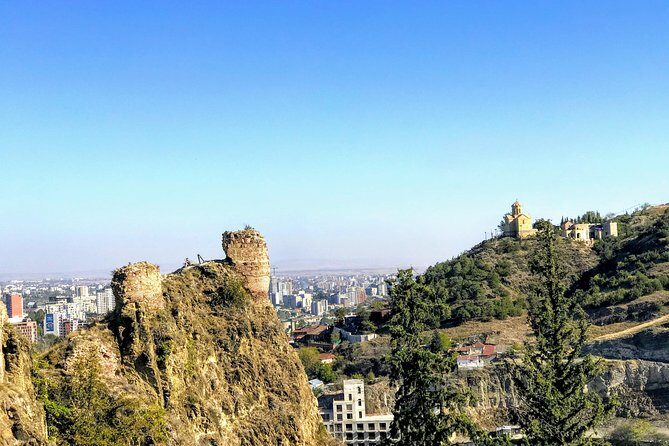
I like starting at Freedom Square because it gives you context in minutes. This is the central square at the eastern end of Rustaveli Avenue, and its story is basically Tbilisi’s story in miniature—named and renamed through Imperial Russia, the Soviet era, and beyond.
If you want an easy first-morning win, this start helps. You don’t just walk past a pretty plaza. You learn why the space feels official, why it became a stage for power, and why today it’s a meeting point for locals heading to work and tourists hunting good photos.
You also get a practical benefit: from here, the rest of the walk makes sense spatially. The guide’s loop pulls you through the “old center” in a way that feels like a guided route, not a random zig-zag. That’s the difference between seeing Tbilisi and understanding it well enough to plan the rest of your days.
Other Tbilisi walking tours we've reviewed in Tbilisi


Wall ruins and Anchiskhati Basilica: the Old Town’s slow, sturdy side
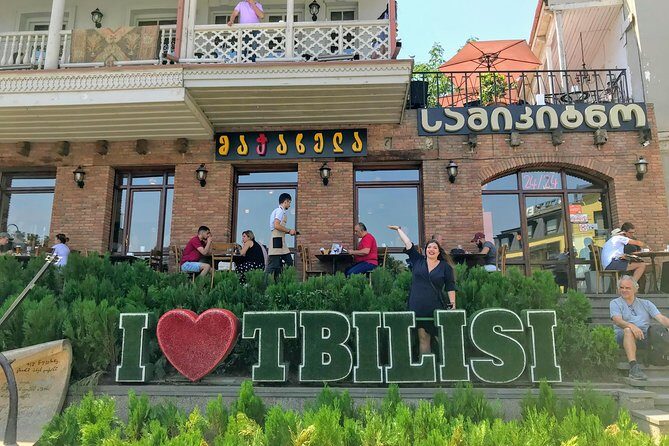
The next stretch turns the volume down from modern square energy to older stone. You’ll pass Tbilisi Wall Ruins, which is exactly what it sounds like: remnants in the old part of the city. It’s a reminder that this place has been defended, rebuilt, and reshaped over centuries, even when the street-level vibe looks relaxed.
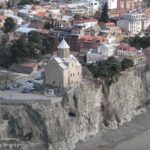
Then you go to Anchiskhati Basilica of St Mary, known as the oldest surviving church in Tbilisi, dating to the 6th century. Even if you’re not a church-detail person, the age alone changes how you see the neighborhood. It’s one of those stops where you can stand still and let your brain catch up.
Two practical notes:
First, places of worship have the same dress requirement (covered knees and shoulders). Second, these short stops work best when you take a few minutes to look slowly—because the architecture and setting can feel subtle compared with the big skyline spots later.
Bridge of Peace and the Mtkvari River: modern Tbilisi shows its new lines
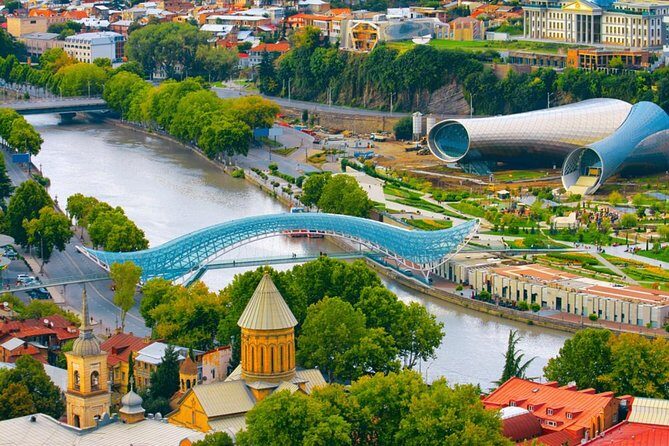
Then the walk crosses into the “newer Tbilisi” chapter with the Bridge of Peace. Opened in 2010 over the Mtkvari (Kura River), it’s one of the city’s newest attractions—and it also functions as a visual divider between old and modern rhythms.
What I like here is the contrast. You get older religious buildings and medieval-looking lanes, then suddenly you’re on a structure designed for today: clean lines, good photo angles, and a clear river perspective. It’s a quick way to see Tbilisi isn’t stuck in the past.
This stop also helps your later route. When you understand where the river sits and how the neighborhoods relate, you make better choices about what to do after the tour. You’ll know where the action is versus where you just get a nice view.
Shardeni Street and Old Town Tbilisi: the best walking pace for photos and people-watching
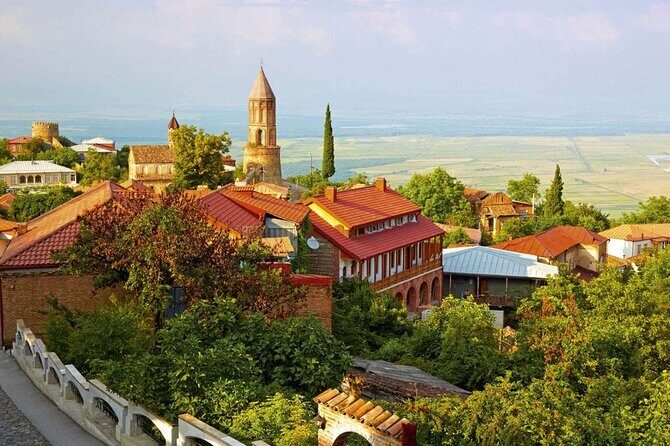
Jan Shardeni Street is where the walk turns into pleasure. It’s a pedestrian street and one of the most popular and beautiful parts of Tbilisi’s center, the kind of place people end up revisiting even if they originally promised themselves they’d only take one stroll.
Expect a more open-feeling route for part of the time. You’ll get space to photograph doorways, balconies, and street corners without feeling like you’re constantly stepping aside for traffic. And because it’s pedestrian-only, your timing is easier.
After that, you move into Old Town Tbilisi, which is where the city’s vibe really sticks to you: old buildings, theaters, and plenty of places to eat. This is the moment when you’ll start thinking about what kind of dinner you want later—because the guide’s route naturally points you toward areas that are lively without needing to hunt.
If you’re traveling with kids or anyone who tires quickly, this section is still manageable. The stops are short enough that you’re not stuck in one long stretch of standing.
Puppet theater, film monuments, and Sayat-Nova’s Armenian legacy
This tour isn’t only architecture. It also tracks cultural memory through monuments and performance.
One of the stops is Rezo Gabriadze Marionette Theater, opened in 1981 and described as a much-loved part of Tbilisi’s cultural scene. Even if you don’t catch a show, the theater helps explain why the arts matter here—not just as museums, but as living, local entertainment.
Then you’ll see Sergey Paradzhanov Monument, tied to the filmmaker whose work brought international praise. The names matter, because they connect Georgia’s cultural output to the wider world: Shadows of Forgotten Ancestors (1964), The Colour of Pomegranates (1969) also known as Sayat-Nova, The Legend of Suram Fortress (1985), and Ashik-Kerib (1988). The monument is a short stop, but it adds weight to the walk.
Next comes Monument of Sayat-Nova, an Armenian poet and musician. It opened in Tbilisi on June 7, 2009, and the sculpture sits near the northern wall of St Kevork Armenian church. This stop gets emotional-fast because of the details: Sayat-Nova hid there during the shah Aga Mohamed Kadjar attack in 1795, and he was killed on the doorstep of the church and buried there.
Even if you only remember one fact from the middle of the tour, make it this one: Tbilisi’s identities overlap here. You’re not just learning “sites.” You’re learning why different communities have shaped the same streets.
Other Tbilisi city tours we've reviewed in Tbilisi





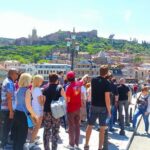
Sioni Cathedral, Jumah Mosque, and the Great Synagogue: one city, many faith shapes
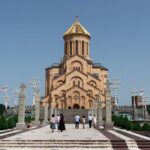
I like that the route threads multifaith Tbilisi without turning it into a textbook. You’ll visit Sioni Cathedral Church, a Georgian Orthodox cathedral also called the Dormition church. Its naming tradition ties it to Mount Zion in Jerusalem, and that’s the kind of small historical detail that makes a building feel connected to a bigger world.
Then you’ll go to Jumah Mosque, or the Friday Mosque. The building is noted for an architectural style that you might not realize is a mosque at first glance. More importantly, it’s one of the rare places where Shias and Sunnis pray together, and it’s open for visitors of all religions or beliefs.
Finally, you’ll reach The Great Synagogue of Tbilisi, built from 1895 to 1903 in an eclectic style by Georgian Jews from Akhaltsikhe who migrated to Tbilisi in the late 19th century. That migration detail helps you see the synagogue not as an isolated monument, but as evidence of real movement and community formation.
Two practical things to remember:
- Dress code applies at worship sites, so keep that fabric in your daypack.
- These stops are quick, so if you want deeper time inside, plan to return later.
Kartlis Deda and the aerial tramway: a city built on hills and viewpoints
Some tours skim views. This one gives you a planned path to the heights, mainly through the aerial tramway plus a key viewpoint monument.
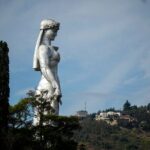
You’ll stop at Kartlis Deda, a 20-meter aluminum statue on Sololaki hill, erected in 1958 for Tbilisi’s 1500th anniversary. It’s the kind of landmark that anchors the hilltop feeling of the city and helps you understand why Narikala and the surrounding heights matter so much.
Then there’s the aerial tramway in Tbilisi connection. The tramway links Rike Park (across the Mtkvari River from the Old Town) to Narikala, the fortress overlooking the city. The catch: the aerial tramway admission is not included, so you decide on the day whether you want that extra step.
If you’re short on time, the tram ride can be the one optional add-on that pays off visually. It also keeps you from doing a long uphill hike in the middle of a walking tour.
Rike Park, bazaars, and the sulphur waterfall finish
The back half of the walk leans toward “hang out” and “wow that’s real” moments.
You’ll spend time at Rike Park, a public recreation area popular with families, tourists, and residents out for a stroll. It’s not only a view spot; it’s also a reset button. After hours of reading stone and monuments, you get a calmer place to breathe and plan your next move.
Then you hit Meidan Bazaar—a practical stop if you want souvenirs without turning the whole day into shopping. It’s also useful because the guide can point you toward what’s worth your time based on your interests.
The tour also includes the Monument Fountain Falcon and Pheasant, tied to a legend about how Tbilisi was established in the 5th century by King Vakhtang Gorgasal. Myth isn’t just story here; it’s part of how people talk about origins and identity.
And your finale is arguably the strangest in a good way: Dzveli Tbilisi Sulphur Waterfall, described as a real waterfall in the city center. It’s the type of stop that makes your brain go, Wait, this is here? It’s memorable, and it’s close to the end of your walk, so you leave with a big visual payoff.
Who this tour fits best (and who should choose differently)
This is a smart choice if you’re in Tbilisi for the first time and want a guided loop that covers major cultural stops in a single morning or afternoon chunk. The duration—about 2.5 to 3.5 hours—is long enough to learn things but short enough to still have time for dinner, museums, or a second walk of your own.
It’s also a strong option if you like when your guide talks through meaning, not just dates. In the way guides are praised for this tour, you’ll often see notes about guides like Jonah, Salomea, Oksana, Tamara, Nini, Gio, Koba, Liza, Aleksi, Sof(a), Khato, and Giorgi being energetic, patient with questions, and helpful with recommendations.
You might want to choose a different plan if you hate walking. The tour requires moderate physical fitness, and you’ll be moving through multiple neighborhoods and stairs-level streets typical of Old Town.
Price and value: why $9 can work (if you use it right)
At $9 per person, this tour is one of those prices that makes you think twice before skipping it. It’s not a discount because it’s skimpy; it’s a discount because it’s built around walking routes and free-entry sights.
Most stops are listed as free admission, so you’re paying for the guide, the route design, and the context. The one notable pay-as-you-go item is the aerial tramway (not included), which gives you control: spend extra if you want the fortress views, skip it if the day is too full.
The tour also uses a mobile ticket, which tends to reduce hassle when you’re trying to focus on the walk. Offered in English, it’s set up for people who want to understand what they’re seeing without needing to research every sign afterward.
Big-picture value tip: do this tour early. It gives you bearings fast, so your solo walking later is cheaper and more satisfying.
FAQ
How long is the Discover Tbilisi walking tour?
It runs about 2 hours 30 minutes to 3 hours 30 minutes.
Is the tour offered in English?
Yes, the tour is offered in English.
How large is the group?
The tour is listed as small-group, with a maximum of 12 people in the tour overview and a maximum of 15 travelers in the additional info.
What is included in the price?
A local guide is included, along with a mobile ticket.
Is the aerial tramway or cable car included?
No. The aerial tramway admission is not included.
Do I need to pay for the stops?
Most stops are free. The aerial tramway is not included.
Where does the tour start and end?
It starts at Freedom Square (BurberryFreedom Square, შალვა დადიანის ქუჩა, Mtawminda 0105, Georgia) and ends back at the same meeting point.
What dress code should I follow?
For places of worship and selected museums, knees and shoulders must be covered for both men and women. Shorts or sleeveless tops are not allowed.
What if I’m running late for the meeting point?
There is a 10-minute waiting time on the meeting point. If you are late or can’t join, you may need to book again.
Can I cancel, and is weather considered?
Free cancellation is available up to 24 hours in advance for a full refund. The experience requires good weather, and if it’s canceled due to poor weather, you’ll be offered a different date or a full refund.
Are service animals allowed?
Yes, service animals are allowed.
Should you book this walking tour?
If you want a low-cost way to get oriented and to understand how Tbilisi’s different communities and eras connect, I’d book it. The mix of major landmarks (Freedom Square, Bridge of Peace, Sioni, Jumah Mosque, synagogue, and Kartlis Deda) plus short stops like the sulphur waterfall makes it a strong first-time plan.
If you’re sensitive to religious-site dress requirements or you prefer fewer stops, you might reconsider. But if you’re up for a well-paced walk with a guide who helps you notice details, this is an easy yes.