REVIEW · TBILISI
Very Friendly Tbilisi Walking Tour (wine tasting & cable car)
Book on Viator →Operated by Fellini Travels · Bookable on Viator
Tbilisi comes at you fast—in a good way. This Very Friendly Tbilisi Walking Tour threads together the city’s most recognizable landmarks with a steady stream of smaller, older stops, so you get your bearings quickly. I like how it’s built around real neighborhoods (not just show-and-tell photo points), with a guide who keeps things personable—Anastasia de Fellini Travels is one example of the friendly vibe people talk about.
Two big pluses for me: the route includes the Narikala cable car (so you get elevation without a long hike), and most stops are free to enter, which makes the $27.24 price feel fair. The only thing I’d flag is pacing: with around 4 hours and short time blocks at each site, it can feel like a lot of moving around, especially around Narikala and the Abanotubani baths area.
In This Review
- Key points before you go
- Value for $27.24: Cable Car + Local Guide + Free Stops
- Meeting point and how the route flows through town
- Old Town First: Tbilisi Wall Ruins, Puppet Theater, and Anchiskhati
- Erekle II Square to Peace Bridge and Rike Park: Old Meets New
- Metekhi Cathedral and Vakhtang Gorgasali: Key icons you can’t miss
- Cable car to Narikala: The best shortcut up and the fortress payoff
- Leghvtakhevi Waterfall and Abanotubani: sulfur-bath district in one sweep
- Meidan Bazaar, Shardeni Street, and Sioni Cathedral: culture you can shop and snack from
- Who this walking tour suits best (and who should skip it)
- Should you book this Tbilisi walking tour?
- FAQ
- How long is the Very Friendly Tbilisi Walking Tour?
- What is the meeting point for the tour?
- Where does the tour end?
- What is included in the price?
- What is not included?
- How big are the groups?
- Is the cable car included, or do I need to buy tickets separately?
- Can children join the tour?
Key points before you go
- Small group feel (max 15): more chat, fewer awkward moments in the back
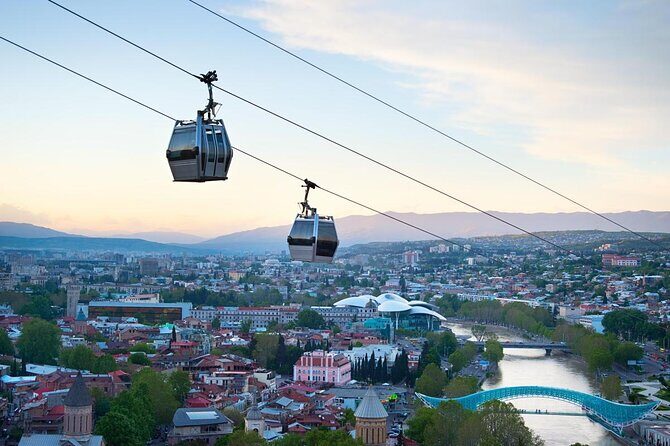
- Cable car included: Rike to Narikala, with easier access to the fortress area
- Mostly free entry stops: you’re not paying extra at every corner
- Old Tbilisi to modern Tbilisi: churches and ruins plus Peace Bridge and Rike Park
- A guide adds context: you’ll hear why these places matter, not just what they look like
- Covered water: bottled water is included for the walk-heavy 4 hours
Value for $27.24: Cable Car + Local Guide + Free Stops

At $27.24 per person for about 4 hours, this tour prices like a practical “see the highlights” option, but it gives you more than a quick highlights walk. You’re paying for a live local guide, bottled water, and the big transport moment: the Tbilisi cable car connecting Rike Park area to Narikala.
What makes the value better is that the itinerary is packed with sights where entry is listed as free. That’s rare on tours that move this much. For you, it means less budgeting stress and more freedom to focus on what you’re actually looking at—architecture, religious sites, and city symbols—without constantly checking what costs extra.
One more value detail: the tour runs as a small-group experience (maximum 15). That matters in Tbilisi because a lot of the interesting stuff is easy to skim if you’re left on your own—old church details, street-level history, and the small “why is this here?” moments.
Other wine tasting tours we've reviewed in Tbilisi


Meeting point and how the route flows through town
You start at Tbilisi Pushkin Square and end near Orbeliani Bazaar (Площадь Орбелиани / near Orbeliani Bazaar). The route is designed to take you from central areas into the old city, then up to Narikala, and back down toward the sulfur-bath district and classic market streets.
A key practical note: the tour time is “about 4 hours,” and the stops are short (often 10–20 minutes). That’s not a museum-style pace. It’s a “walk, look, learn the basics, then move on” style—perfect if you want context and structure, but not ideal if you’re the type who needs long, quiet time inside churches or lingering views for an hour at a time.
If you’re sensitive to stairs or uneven streets, plan to take your time around Narikala and the old-city lanes. The cable car helps, but you’ll still walk and navigate old stone streets.
Old Town First: Tbilisi Wall Ruins, Puppet Theater, and Anchiskhati
This tour starts with the kind of sights that teach you how Tbilisi was built—literally on layers.
- Tbilisi Wall Ruins (Old customs gate area): You get a quick window into 11th-century underground heritage. Even with limited time, ruins like this change how you see the city streets. They make you understand that today’s routes grew out of older boundaries and movement corridors. Free entry makes it low-pressure: you can spend the time you want, without worrying about a ticket decision.
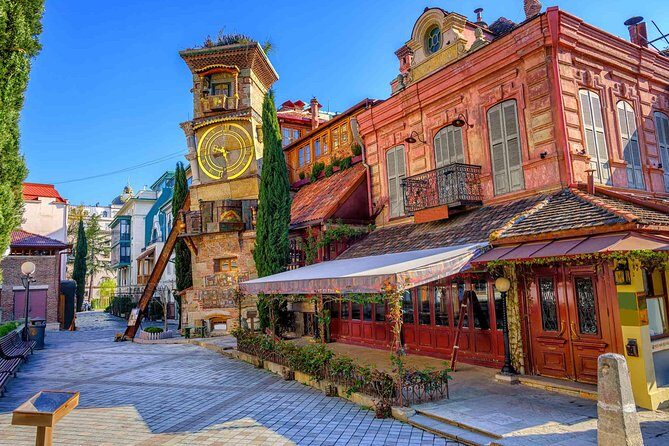
- Rezo Gabriadze Marionette Theater: This stop is memorable because it’s not just “a theater building.” It’s tied to a specific creator (Rezo Gabriadze) and has a signature feature: once an hour, a golden angel comes out and rings a bell with a small hammer. It’s the kind of detail that turns a quick stop into a story you’ll remember later.
- Anchiskhati Basilica: This is a fast but meaningful stop. Anchiskhati is a three-nave basilica from the 6th century, and it’s described as the oldest church building in Tbilisi. You’ll also hear about the icon history linked to the Savior of Anchi and the fact it’s carved by Beka Opizari (with the icon currently kept in the Georgian National Museum). If you’re into religious art, even a brief mention of who carved what—and where it ended up—adds real texture.
One small drawback of this section: because each stop is around 10–15 minutes, you won’t get a full “read every inscription” experience. But as an orientation sweep through old Tbilisi, it’s a strong opener.
Erekle II Square to Peace Bridge and Rike Park: Old Meets New

After the medieval core, the route shifts toward areas that show how Tbilisi remade itself in recent decades.
- Patriarchate of Georgia area (Erekle II Square): You’ll see the seminary building linked to the Russian Orthodox Church era. Construction began in 1809 on earlier palace ruins tied to Tsarist Russia, and later the Exarch and related services were established there. Even if you only stay a short time, it’s a useful “political geography” lesson—Tbilisi’s religious buildings aren’t just spiritual; they also reflect power.
- The Bridge of Peace: This is one of Tbilisi’s modern symbols, and it’s easy to understand why. The bridge opened May 6, 2010, and it’s associated with architect Michele de Luca and lighting designer Philippe Martino. When you see a bridge like this after older churches and ruins, you start to notice how the city balances preservation with reinvention.
- Rike Park: Rike is a “walk-through” park stop, but it has a quirky feature: from above, the pathways and overall layout form a large-scale map of Georgia, with routes depicting different regions. It’s a clever way to get a sense of national identity without a lecture.
This midsection is good value because it’s not only pretty. It helps you read Tbilisi as a place where old and new are physically connected.
Metekhi Cathedral and Vakhtang Gorgasali: Key icons you can’t miss
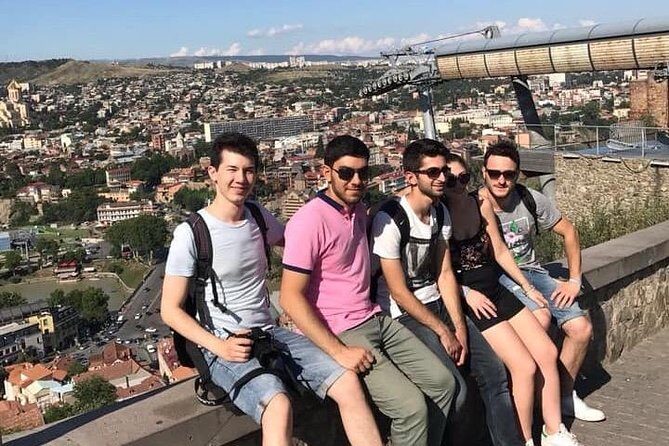
Next you’ll land in another layer of meaning—religion and national myth—then you’ll head toward the cable car ascent.
- Metekhi Cathedral (Church of the Nativity of the Virgin Mary): This stop centers on the tomb of St. Shushanik. You’ll hear that after an ecclesiastical split at the beginning of the 7th century, the remains were transferred to Metekhi. Queen Tamar is also mentioned in connection with honoring the saint’s body with gilded clothes. Again, you don’t need long time here to feel how Tbilisi links faith, saints, and royal storytelling.
- Monument of King Vakhtang Gorgasali: This is the national-symbol stop. Vakhtang I Gorgasali is tied to the 5th–6th century and the Kartli/Iberia power struggle against Sasanian hegemony with Byzantine alliance. Even a short mention gives you an anchor for understanding why some statues in Tbilisi are treated like “chapter headings.”
- Kartlis Deda (Mother of Kartli): This statue is one of the easiest to understand. One hand holds a wine glass for guests, the other holds a sword for enemies. It’s a neat way to summarize the national self-image—hospitality paired with readiness.
These stops are fast, but they work because they give you symbols you’ll recognize later as you wander on your own.
Other Tbilisi walking tours we've reviewed in Tbilisi




Cable car to Narikala: The best shortcut up and the fortress payoff

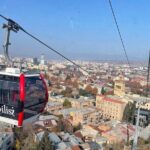
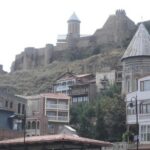
The Tbilisi Cable Car is included, and it’s a smart move for the route. The cable car links the Rike Park/Europe Square area to the fortress of Narikala. For most people, that turns a steep, time-consuming walk into a quick ride with views and momentum.
Then you’re at Narikala Fortress, which the tour describes as having fragments going back to the 4th century AD, with later expansions, including Arab fortification work in the 7th–8th centuries. The fortress area also includes St. Nicolas temple (12th century).
What’s great about making this part of a guided walk is that Narikala can feel like “just a hill” if you’re not told what you’re seeing. Even in a short window, the guide context helps you notice the layers—construction, expansion periods, and why the place is culturally important.
Right after Narikala, you’ll pass by the Juma Mosque, located below the fortress in Old Tbilisi. It’s described as the only Muslim shrine in the city. The history you’re given includes:
- the Ottomans building the first Sunni mosque (1723–1735)
- destruction by Persians in the 1740s
- rebuilding (1846–1851) by architect Giovanni Scudieri
- major renovation in 1895 by Hajizinelabdin Tagiyev, significantly altering the eastern part
This is one of the route’s best “Tbilisi is multi-faith” lessons. It’s also visually distinct, and it gives you something different from the Christian monuments.
Leghvtakhevi Waterfall and Abanotubani: sulfur-bath district in one sweep

After Narikala, you move toward the old-city gorge and the famous bath area.
- Leghvtakhevi Waterfall: You’ll see the waterfall described as 22 meters tall. The name comes from the Georgian word for fig—Leghvi—with a note that there used to be many fig trees around. This stop works because it’s not “just a waterfall.” It’s tied to how the old district area (Kala) was separated by the gorge.
- Abanotubani: This is where the city’s sulfur-bath tradition becomes the center of the map. The area is known for its sulphuric baths, supported by hot sulfur springs. The baths were built over time, roughly 17th–19th centuries, and the oldest listed is the Irakli bath, tied to ownership arguments between the imperial family and Georgian princes in the 16th century.
- Chreli Abano: You’ll visit a popular bath spot described as so recognizable it looks like a mosque, but it’s a sulfur bath. Even if you don’t plan to bathe, the chance to see how this district is arranged and how it fits into old Tbilisi streets is worth the stop.
If you want a practical tip: plan your time here for walking and watching the district flow. This section tends to be where people get tempted to linger. Since the tour is time-based, you’ll want to balance “look longer” with the fact that the schedule moves on.
Meidan Bazaar, Shardeni Street, and Sioni Cathedral: culture you can shop and snack from
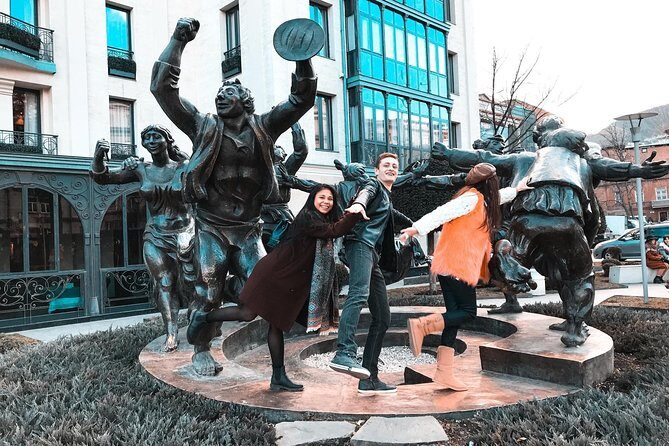
Once you’re back toward the city center, the tour leans into street life.
- Meidan Bazaar: You’ll spend time in this commercial square area. It’s linked to French traveler Jean Sharden, who mentioned the place in the 18th century. The tour notes that it’s always been a commercial square, under different names—Shaitan Bazaar, Tatris Moedani, Tsikhis Moedani. Most importantly for your day-to-day: if you want traditional Georgian wine, handmade accessories, souvenirs, or delicacies, this is a practical place to look.
This is also where the wine theme makes sense. Even when you’re not doing a formal tasting session, spending time at a market focused on wine makes it easier to buy something you’ll actually use later at home.
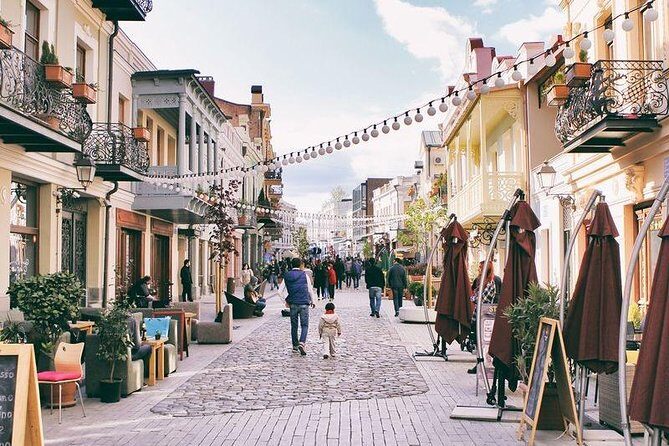
- Jan Shardeni Street: This is the pedestrian “hang out” street. It’s named after Jean Chardin after a reconstruction in the 19th century. The street and its nearby parallels—Bambis Rigi and Rkinis Rigi—plus Erekle II northward, are described as narrow pedestrian lanes with galleries and cafes. It’s a good last stretch to decompress after the stairs and fortress views.
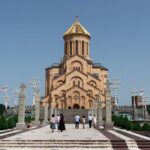
- Sioni Cathedral Church (Assumption of the Blessed Virgin Mary): You’ll finish with Sioni Cathedral, tied to Georgian architecture and described as a cross-domed temple. It’s dated from the 5th century to the present, and since 1920 it’s the Patriarchal Cathedral. This stop works as a spiritual “full stop” after all the symbols, ruins, and bath district energy.
Ending near Orbeliani Bazaar is convenient too. It gives you an easy point to continue shopping or grab food on your own.
Who this walking tour suits best (and who should skip it)
This tour is a good match if you want:
- a guided way to cover a lot of Tbilisi in about 4 hours
- a route that mixes old churches and ruins with modern landmarks like the Peace Bridge and Rike Park
- included value like bottled water, a local guide, and the cable car
- a small-group setting (max 15) with more space for questions
You might want to skip it (or choose a slower option) if:
- you prefer long stays inside buildings and hate short “20-minute stops”
- you’re not comfortable walking through hilly, old-street areas even with a cable car ride
Should you book this Tbilisi walking tour?
Yes—if you want a friendly, structured way to orient yourself and see the big ideas of Tbilisi without paying extra at every site. The $27.24 price feels justified because the tour includes the cable car, a local guide, and bottled water, while most stops are listed as free entry.
If your main goal is to soak slowly, linger, and take time for interior details, it may feel a little rushed. But for most first-time visitors who want history context, a sense of Tbilisi’s identity, and a practical walking plan, this is an easy yes.
FAQ
How long is the Very Friendly Tbilisi Walking Tour?
It lasts about 4 hours.
What is the meeting point for the tour?
The tour starts at Tbilisi Pushkin Square.
Where does the tour end?
It ends near Orbeliani Bazaar (Площадь Орбелиани).
What is included in the price?
Bottled water, a local guide, and the Tbilisi cable car are included. Most listed sights have free admission.
What is not included?
Food and drinks are not included. Hotel pickup and drop-off are listed as not included.
How big are the groups?
The tour is a small-group experience with a maximum of 15 people. The overall activity has a maximum of 100 travelers.
Is the cable car included, or do I need to buy tickets separately?
The aerial tramway in Tbilisi (cable car) is included.
Can children join the tour?
Children must be accompanied by an adult.